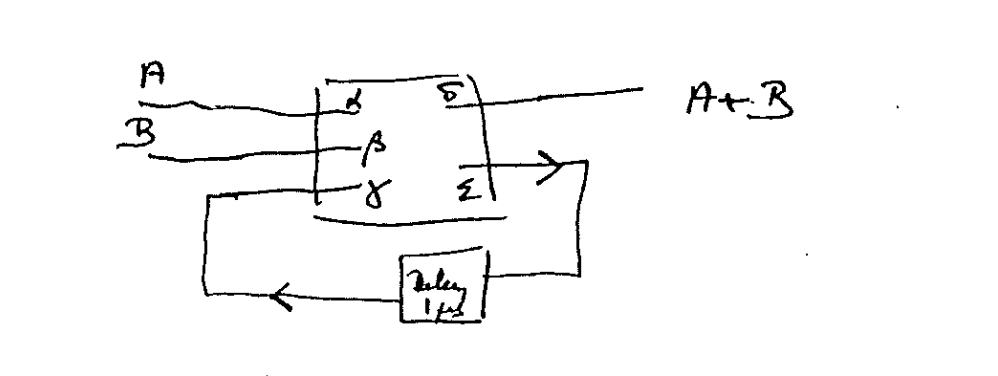
In his 1947 “Lecture to the London Mathematical Society,” Alan Turing writes that the possibilities for how an automatic computing engine (ACE) might be used and manipulated are “immense.” But so too are the challenges posed by demands not only for ever-more memory but also the “maintenance of an appropriate discipline, so that we [mathematicians] do not loose task of what we are doing” (120). In order for the ACE and similar machines to operate, the people who run them will themselves need “a number of efficient librarian types” to keep them (the mathematicians who are the operators) in order. Like machines, humans need discipline, structure, and organization.
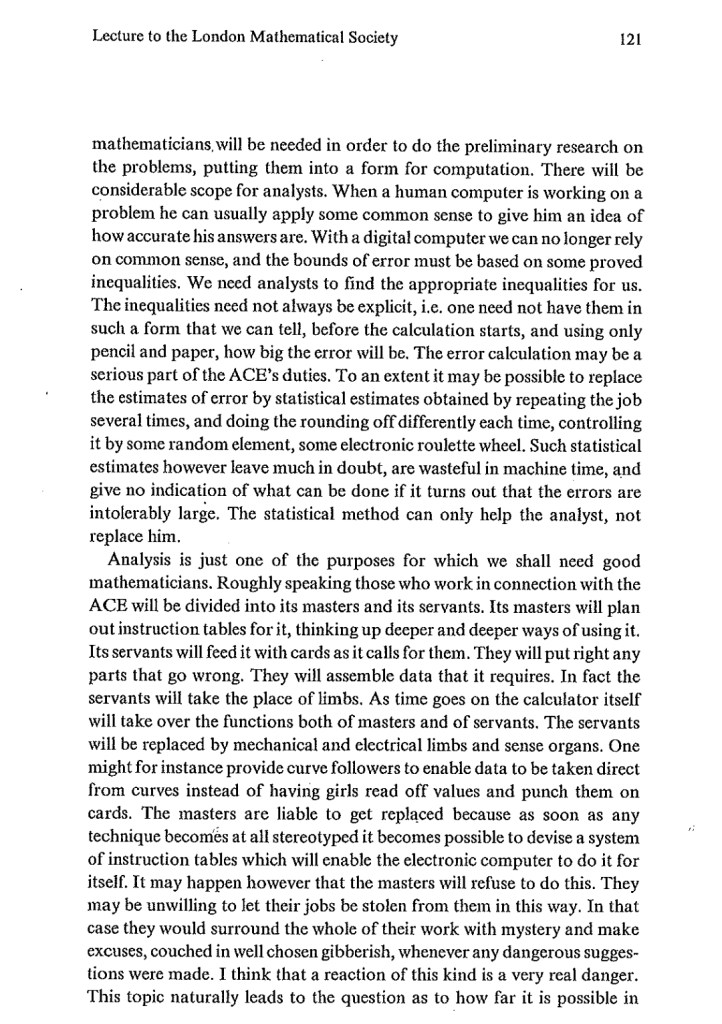
Turing, then, turns to speculation about the effects automatic computing machines might have on future mathematicians. As such machines increase in number and computational and storage capacity, he conjectures, mathematicians will be divided into “masters” and “servants,” those who plan instructions for the machines and those who feed these instructors (via punch cards) into machines (121). This division of labor––not only between humans and machines but also among humans themselves––will be provisional, however. “Masters” themselves will be replaced as digital computers usurp the functions of both “masters and servants.” At that point, the prospect of automatic computing machines simulating “human activities” would be neither a theoretical game or philosophical puzzle. It would be a practical and “dangerous” problem. Future mathematicians might be “unwilling to let their jobs be stolen from them.” In order to defend their work, they might shroud it in “gibberish” and “mystery,” making excuses for what machines till can’t do.
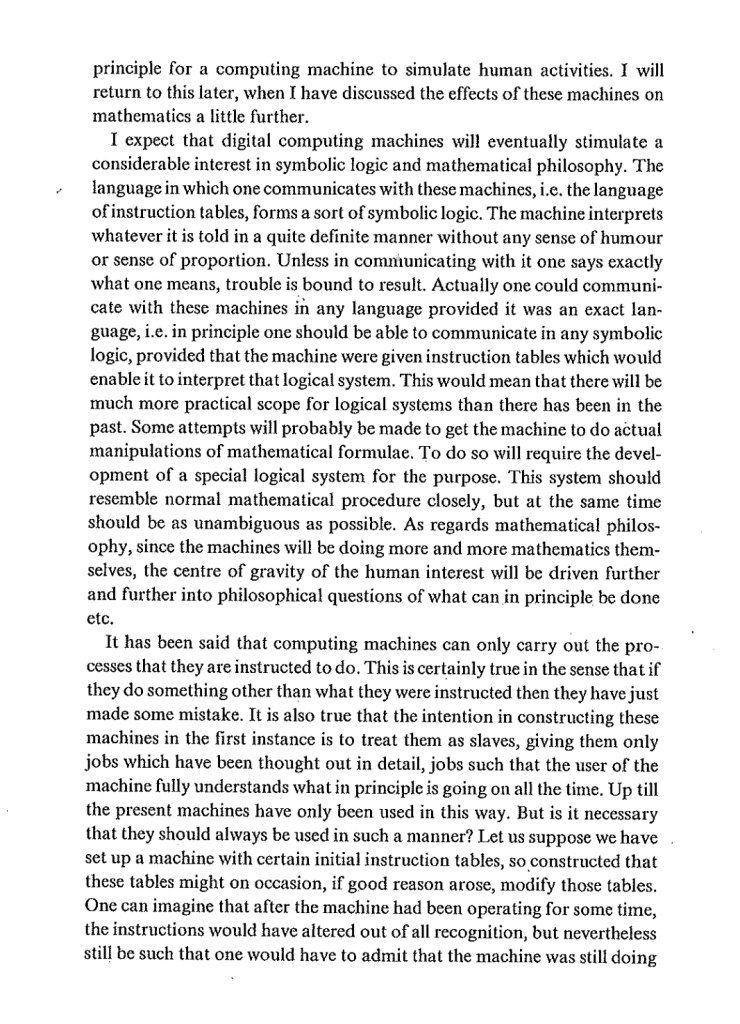
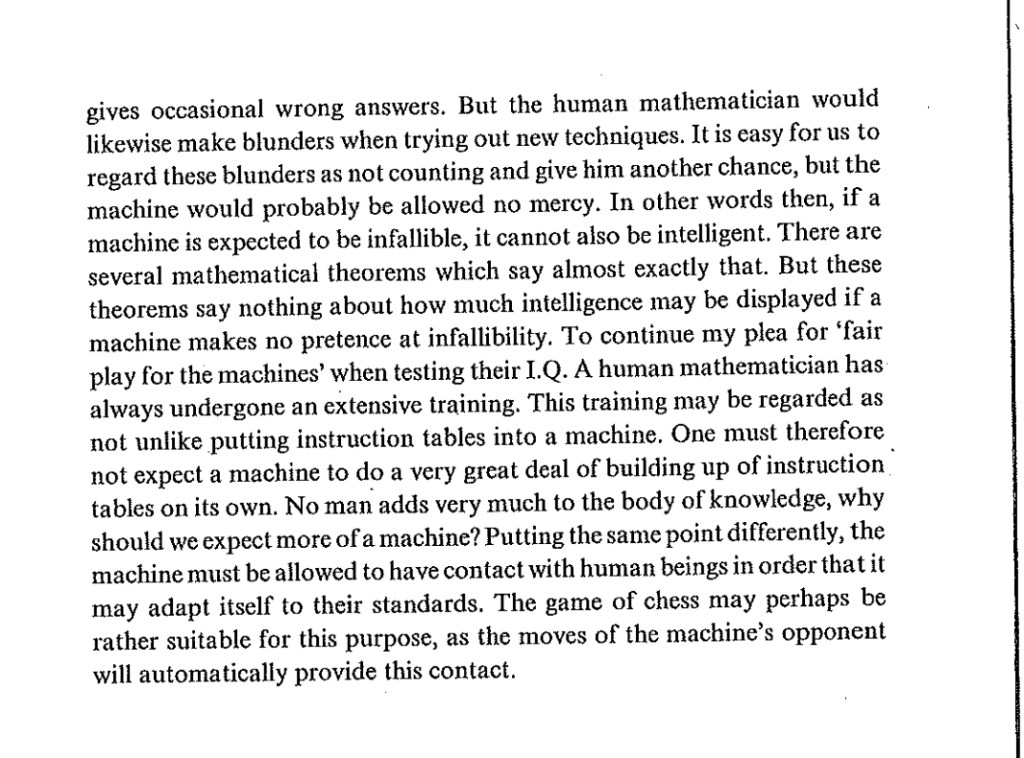
In this version of the question, Turing turns ‘can machines think?’ not into a game, but into a question of power––humans have built such machines with the intention of treating them as “slaves” (122)––and the division of labor. This version of the question leads in ways similar and not to the more well-known discussion in “Computing Machinery and Intelligence” (1950) of the relationship between intelligence, rationality, and creativity. In the 1947 lecture, Turing ties these capacities to “training” and imitation. Putting instruction tables into a machine (programing a machine) is not, he concludes, unlike “training a mathematician” (124). “No man,” he writes, “adds very much to the body of knowledge. Why should we expect more of a machine?”
I’m not sure what to make of Turing’s emphasis on training, imitation, and instruction over the explicit rule-following required by “instruction tables.” Although he doesn’t point to older rhetorical traditions of inventio or imitatio, he blurs the line line between humans and machines in ways that remind me of other, older models of intelligence and rationality. Here are three pages from the lecture (120, 121, 124).
 Chad Wellmon
Leave a comment